
21 Jan
What SEO Marketing Really Means for Your Business
SEO marketing is the process of improving your website’s visibility in search engines like Google to attract more customers without paying for ads. Here’s what you need to know:
What SEO Marketing Includes:
- On-Page Optimization – Making your website content and structure search-friendly
- Off-Page Building – Earning links and mentions from other websites
- Technical Setup – Ensuring Google can easily find and understand your site
- Content Creation – Publishing helpful information that answers customer questions
- Performance Tracking – Measuring traffic, rankings, and conversions
Why It Matters: Google drives 63.41% of all US internet traffic. If your business isn’t showing up in search results, you’re invisible to most potential customers.
You offer great products or services, but that doesn’t matter if customers can’t find you. When someone in your area searches for what you offer, are you there, or are your competitors getting all the clicks?
Search engine optimization isn’t a mysterious art. It’s a learnable process that helps search engines connect your site with people looking for what you provide. Unlike paid ads that stop when you stop paying, SEO builds momentum over time. Every optimized piece of content, earned link, and technical improvement compounds to create a stronger online presence.
This guide breaks down what you need to know about SEO marketing, focusing on what works for local businesses in Riverside, Los Angeles, Palm Springs, San Diego, and Moreno Valley.
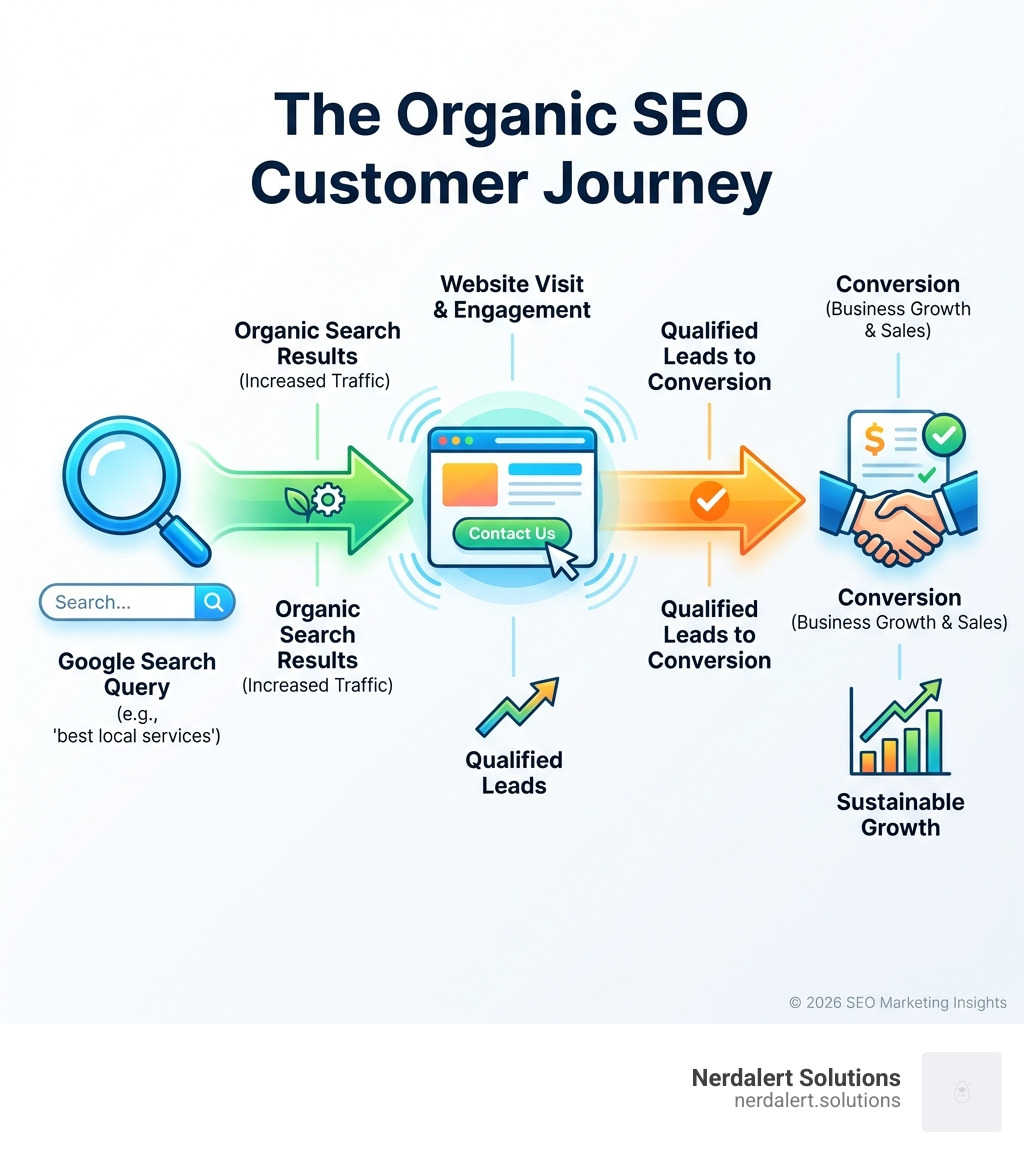
What is SEO and Why Does Your Business Need It?
At its core, SEO marketing is the practice of improving your website’s traffic from unpaid (organic) search results. Think of it as helping Google see your business as the best answer for potential customers.
Search engines are sophisticated “answer machines.” They use complex algorithms to find and rank the most relevant and valuable pages for any search query. Our job in SEO is to optimize our site’s content and structure to show search engines—and users—that our website is the best answer.
Understanding the Core of SEO Marketing
SEO marketing focuses on earning “organic” results—the natural, unpaid listings on a search engine results page (SERP). You don’t pay per click for these; you earn them through strategic optimization.
The process involves three key elements:
- Crawling: Search engines use programs called “crawlers” (like Googlebot) to find new and updated web pages by following links.
- Indexing: The information gathered is then processed and stored in a massive index, like a digital library. If your page isn’t indexed, it can’t appear in search results.
- Ranking: When a user searches, the engine sifts through its index to find and rank the most relevant pages based on hundreds of factors, presenting them on the SERP.
The beauty of SEO marketing is its long-term impact. When done right, it builds trust and authority for your brand, which creates immense credibility over time for customers in places like San Diego.
SEO vs. SEM: Clarifying the Confusion
The terms SEO and SEM are often confused. Here’s the difference:
- Search Engine Marketing (SEM): The umbrella term for all activities to increase search engine visibility. It includes both SEO and paid search.
- SEO (Search Engine Optimization): Focuses on earning organic, unpaid results.
- Paid Search (Pay-Per-Click or PPC): Involves paying for ads that appear on SERPs.
Here’s a quick comparison:
| Feature | SEO (Organic) | SEM (Paid Search/PPC) |
|---|---|---|
| Cost | Free clicks, but requires investment in time/effort | Paid per click or impression |
| Speed | Slower to see results (weeks to months) | Immediate visibility |
| Visibility | Sustained, builds over time | Stops when you stop paying |
| Trust | Higher perceived credibility, builds authority | Clearly labeled as an ad, can be less trusted |
| Control | Less direct control over ranking | Full control over ad copy, budget, targeting |
| Long-term Value | High, compounding asset | Transactional, short-term |
While distinct, SEO and PPC are often complementary. Paid ads can provide immediate visibility while your SEO efforts build momentum. For businesses in Riverside, CA, a combined approach often yields the best results. Our team can help you craft 10 Effective Strategies to Improve Your Search Engine Rankings that cover both.
Why is SEO Marketing Important for Businesses?
“If you’re not on the first page of Google, you might as well not exist.” This statement highlights a key truth: with Google driving most internet traffic (63.41% in the US) and 42% of shoppers using search engines for research, visibility is essential. Here’s why SEO marketing is non-negotiable for your business, whether you’re in Los Angeles, Palm Springs, or anywhere else:
- Increased Visibility and Traffic: Higher rankings for relevant keywords lead to more visibility, clicks, and potential customers. Organic search delivers over 53% of all website traffic globally.
- Higher Credibility and Trust: People trust organic results more than ads. A high ranking signals that Google considers your site a reliable, authoritative source, which is invaluable for building trust.
- Better User Experience: Good SEO focuses on pleasing users. Optimizing for speed, mobile-friendliness, and clear navigation improves user experience, which in turn helps rankings.
- Cost-Effectiveness and High ROI: Though SEO requires investment, the resulting traffic is “free.” It offers a higher long-term ROI compared to paid advertising, paying dividends for years.
- Brand Awareness: Consistently appearing at the top of search results builds brand recognition and familiarity, even if users don’t click immediately.
- Insights into Customer Behavior: SEO data provides deep insights into customer searches, pain points, and interests, which can inform your entire business strategy.
In short, SEO marketing is a fundamental business strategy that ensures your products or services are found by the people who need them most. For more details on how we can help your business, check out our SEO Services.
The Three Pillars of a Winning SEO Strategy
A successful SEO marketing strategy rests on three interconnected pillars: On-Page SEO, Off-Page SEO, and Technical SEO. Neglecting one can compromise your entire effort.

Pillar 1: On-Page SEO
This pillar covers the content on your website and the HTML elements that make it understandable to users and search engines.
- Content Quality: Create helpful, reliable, and unique content that answers user questions and demonstrates Expertise, Experience, Authoritativeness, and Trustworthiness (E-E-A-T).
- Keyword Research & Integration: Identify the terms your audience uses and integrate them naturally into your content without “stuffing.”
- Title Tags: The clickable headline on the SERP. It must be clear, concise, and include your primary keyword to encourage clicks.
- Meta Descriptions: The summary below the title on the SERP. While not a direct ranking factor, a compelling description improves click-through rates.
- Header Tags (H1, H2, etc.): Use these to structure content like an outline. They improve readability and help search engines understand your page’s topics.
- Image Optimization: With 34.7% of Google searches returning images, optimization is crucial. Use descriptive filenames, add alt text for accessibility and SEO, and compress images for speed.
- Internal Linking: Link to relevant pages on your own site to guide users, help search engines find content, and spread authority.
For a deeper dive into crafting these elements, explore The Ultimate Guide to the Best SEO Strategies.
Pillar 2: Off-Page SEO
This pillar focuses on activities outside your website that signal its authority and trustworthiness, essentially building its reputation online.
- Backlinks: Links from other websites are like votes of confidence. High-quality, relevant backlinks make your site appear more authoritative to search engines like Google, whose PageRank algorithm analyzes these links. Understanding this is key to Unlock the Power of SEO Link Building: Essential Techniques for Beginners.
- Link Building: The strategic process of acquiring backlinks through creating link-worthy content, digital PR, and outreach.
- Domain Authority: A metric from third-party tools that estimates your site’s overall strength based on its backlink profile. Higher authority often correlates with better rankings.
- Brand Mentions: Unlinked mentions of your brand can still be picked up by search engines as signals of your prominence and relevance.
- Social Signals: While not a direct ranking factor, social media activity can indirectly boost SEO by increasing visibility, traffic, and potential backlinks.
Pillar 3: Technical SEO
This pillar ensures your website’s foundation is solid, making it easy for search engines to crawl, understand, and index your content.
- Site Speed: Fast-loading sites are prioritized by search engines because users prefer them, especially on mobile (over 60% of traffic). Faster sites lead to better rankings.
- Mobile-Friendliness: Google uses mobile-first indexing, meaning your site’s mobile version is primary for ranking. It must be responsive and provide a seamless experience on all devices.
- Crawlability & Indexing: Your site must be easy for search engines to find (crawl) and add to their database (index). Use tools like
robots.txtand XML sitemaps to guide crawlers. As Google’s trends analyst Gary Illyes once put it, “MAKE THAT DAMN SITE CRAWLABLE.” - Structured Data (Schema Markup): Add this code to your site to help search engines understand your content. It can enable “rich results” (like star ratings or FAQs) that make your listing stand out.
- Site Architecture: A logical site structure with clear navigation helps users and search engines find content easily.
- HTTPS Security: A secure (HTTPS) website is a ranking factor that builds user trust by encrypting data.
Key Tactics to Implement Your SEO Marketing Strategy
Knowing the pillars is one thing; putting them into action is another. Here are key tactics we at Nerdalert Solutions use to implement a robust SEO marketing strategy for businesses in San Diego, Riverside, and Los Angeles.
Mastering Keyword Research
Before you write a single word, you need to know what your audience is searching for. This is the compass guiding your entire SEO marketing journey.
- Search Volume & Keyword Difficulty: Find the sweet spot between how many people search for a term (volume) and how hard it is to rank for it (difficulty). Aim for keywords with decent volume that aren’t impossibly competitive.
- Long-Tail Keywords: Use longer, specific phrases (e.g., “best dog groomer in Moreno Valley”). They have lower search volume but higher user intent, leading to more qualified leads.
- User Search Intent: Understand why a user is searching. Are they informational, navigational, or transactional (ready to buy)? Match your content to their intent.
- Competitor Keywords: Analyze the keywords your competitors rank for to find opportunities and gaps in your strategy.
Start with free tools like Google Keyword Planner and Google Search Console. For deeper insights, consider professional tools like Ahrefs and Semrush.
Creating High-Value, Optimized Content
Once you know what people are searching for, you must create content that answers their questions and provides real value.
- Answer User Questions: Design your content to thoroughly answer the questions your target audience is asking.
- Readability & Structure: Use headings, bullet points, and short paragraphs to make your content easy to scan and digest.
- Originality & Depth: Offer unique perspectives or deeper insights instead of rehashing content. Keep it updated to signal relevance.
- E-E-A-T (Expertise, Experience, Authoritativeness, Trustworthiness): Google emphasizes these qualities. Ensure content is written by knowledgeable individuals and backed by credible sources. Human oversight is crucial, as AI-generated content lacking E-E-A-T may be rated as “Lowest quality.”
For more strategies on optimizing your written content, check out our guide on how to Improve the Organic CTR for Your Pages Blog Posts.
Building Authority with Strategic Link Building
Think of backlinks as endorsements from other websites. The more reputable sites that endorse yours, the more authority Google will assign to your site.
- Earning Backlinks: The best backlinks are earned naturally when others reference your valuable content, such as data, infographics, or in-depth guides.
- Digital PR: Actively promote your content to journalists, bloggers, and influencers to earn features and links.
- Broken Link Building: Find broken links on relevant sites, create replacement content, and suggest your page as an alternative.
- Resource Page Link Building: Find resource pages in your niche and suggest your site as a valuable addition.
- Unlinked Brand Mentions: Find mentions of your brand without a link and politely ask for one to be added.
- Guest Blogging: Write high-quality articles for reputable sites in your industry to earn valuable backlinks.
These tactics, when executed strategically, can significantly boost your website’s authority and search engine rankings. If you’re looking to improve your backlink profile, our team offers Boost Your Rankings with Expert Link Building SEO Services.
Measuring Success and Navigating the Future of SEO
If you can’t measure it, you can’t improve it. In SEO marketing, tracking progress is about understanding what’s working and how to adapt. This is also essential for navigating the changing landscape of search.
How to Measure the Success of Your SEO Marketing
To understand the impact of your SEO marketing efforts, we focus on several Key Performance Indicators (KPIs):
- Organic Traffic: How many visitors are coming to your site from unpaid search results? Track the volume and trends over time.
- Keyword Rankings: Where does your website appear on the SERP for your target keywords? Improvement here directly correlates with increased visibility.
- Click-Through Rate (CTR): The percentage of people who see your listing on the SERP and click it. A higher CTR indicates your title tags and meta descriptions are compelling.
- Conversion Rate: This measures how many organic visitors complete a desired action, like filling out a contact form, making a purchase, or calling your business.
- Bounce Rate: The percentage of visitors who leave your site after viewing only one page. A high bounce rate might indicate your content isn’t meeting user expectations.
- Backlink Profile Analysis: Regularly reviewing the quality and quantity of your backlinks helps ensure you’re building a healthy, authoritative link profile.
Tools like Google Analytics and Google Search Console are indispensable for tracking these metrics. For local businesses, especially in San Diego, we also pay close attention to local search metrics. Learn more about this at Google Maps SEO San Diego.
Future-Proofing Your Strategy: SEO Trends
The world of SEO marketing is constantly evolving. Here’s what we’re watching to future-proof our strategies:
- AI in Search & Generative Engine Optimization (GEO): AI is rapidly changing search. Google’s AI Overviews are changing how information is presented. GEO is an emerging approach focused on optimizing content for inclusion in these AI-generated answers. This means providing concise, accurate, and structured answers. You can read more about this at What is generative engine optimization (GEO)?.
- Voice Search Optimization: As smart devices become ubiquitous, optimizing for conversational queries and natural language is increasingly important.
- Zero-Click Searches: More users are finding answers directly on the SERP through features like featured snippets and AI Overviews. Our strategy now includes optimizing content to appear in these “zero-click” results.
- Video SEO: With the rise of YouTube and TikTok, optimizing video titles, descriptions, and tags for search is a growing area.
- User Experience (UX) Signals: Google continues to prioritize user experience. Core Web Vitals (site speed, interactivity, visual stability) are direct ranking factors.
- Mobile-First Indexing: This is a current reality. Google’s mobile-first indexing was completed in 2023, meaning your mobile site is the primary version used for ranking.
The SEO marketing landscape is always shifting, but by focusing on user value, technical excellence, and adaptability, we can ensure your business stays ahead of the curve.
Frequently Asked Questions about SEO Marketing
We often get asked common questions about SEO marketing. Here are some straightforward answers:
How long does it take to see results from SEO?
This is a common question, and the answer isn’t always quick! While minor changes might show effects in hours, significant improvements in traffic and rankings typically take 4-6 months, sometimes longer for competitive industries. It’s generally recommended to wait a few weeks to assess the effects of major changes. SEO is a marathon, not a sprint, but the long-term rewards are substantial.
Is SEO a one-time effort or an ongoing process?
SEO marketing is an ongoing process. Think of it like maintaining a garden. Search engine algorithms are constantly updated, competitors are always trying to outrank you, and user search behavior evolves. To maintain and improve your rankings, continuous monitoring, analysis, and content updates are essential.
Can I do SEO myself, or do I need to hire an expert?
Yes, you can learn basic SEO marketing yourself. There are many free resources and tools available to get you started.
However, comprehensive SEO requires significant time, specialized knowledge, and professional tools. Hiring an expert or agency like Nerdalert Solutions brings several advantages:
- Expertise: Professionals like our Digital Marketing Director, Cathal Melinn, have in-depth knowledge of algorithms and emerging trends from over 15 years of experience.
- Time Savings: An expert handles the heavy lifting, freeing you to focus on your business.
- Faster Results: With specialized knowledge, experts can often achieve results more efficiently.
- Holistic Strategy: An agency can integrate SEO into a broader digital marketing strategy, ensuring all your online efforts work together.
For businesses in competitive markets like Los Angeles or San Diego, a professional approach can make a significant difference in achieving top rankings.
Conclusion: Start Winning with SEO
In the dynamic digital landscape, SEO marketing is no longer optional; it’s fundamental to your business’s online success. We’ve explored its core principles, clarified its distinction from SEM, and highlighted why it’s so crucial for visibility, credibility, and sustained growth.
Remember the three pillars of a winning strategy:
- On-Page SEO: Optimizing the content and elements directly on your website.
- Off-Page SEO: Building your website’s authority and reputation across the web.
- Technical SEO: Ensuring your site’s foundation is solid for search engine crawlers.
Implementing these tactics, from mastering keyword research to building high-value content and strategic backlinks, requires dedication and a continuous learning mindset. It’s a long-term investment, but one that yields compounding returns, helping your business charm Google and win more customers.
At Nerdalert Solutions, we specialize in delivering custom, data-driven strategies that consistently boost our clients’ Google rankings and generate high-quality leads for businesses across Riverside, Los Angeles, Palm Springs, San Diego, and Moreno Valley. We understand the local market nuances and global SEO best practices.
Don’t let your competitors capture all the attention. Take the next step towards a stronger online presence.