04 Feb
Why Mastering Web Design Matters in Today’s Digital Landscape
To master web design is to pursue advanced expertise in creating sophisticated, user-centered digital experiences that drive business results. Here’s a quick overview:
Quick Answer: What Does It Mean to Master Web Design?
- Advanced Education: Pursuing a master’s degree or professional certificate in digital media design, web development, or a related field.
- Core Skills: Mastery of HTML, CSS, JavaScript, UX/UI principles, responsive design, and accessibility standards.
- Career Outcomes: Leads to roles like UX Architect, Creative Director, or Senior Front-End Developer.
- Time Investment: Programs range from 2-5 years, depending on full-time vs. part-time study.
- Salary Range: Senior positions can earn $80,000-$100,000+ annually.
A high-quality website is crucial for success. Many businesses struggle with low traffic and poor rankings because their sites lack the sophisticated user experience modern audiences expect. A great website isn’t just about aesthetics; it’s about creating an experience that converts visitors into customers.
The digital landscape has evolved far beyond basic HTML and CSS. Modern web design demands an understanding of responsive layouts, accessibility, user research, and emerging technologies like AI and voice interfaces. Professionals who master these skills are increasingly valuable across all industries.
This guide explores the strategic value of advanced web design education and what it takes to truly master this dynamic field, whether you’re a designer seeking to deepen your expertise or a business owner aiming to understand what defines great web design.
Why Go Beyond a Certificate? The Strategic Value of a Master’s Degree
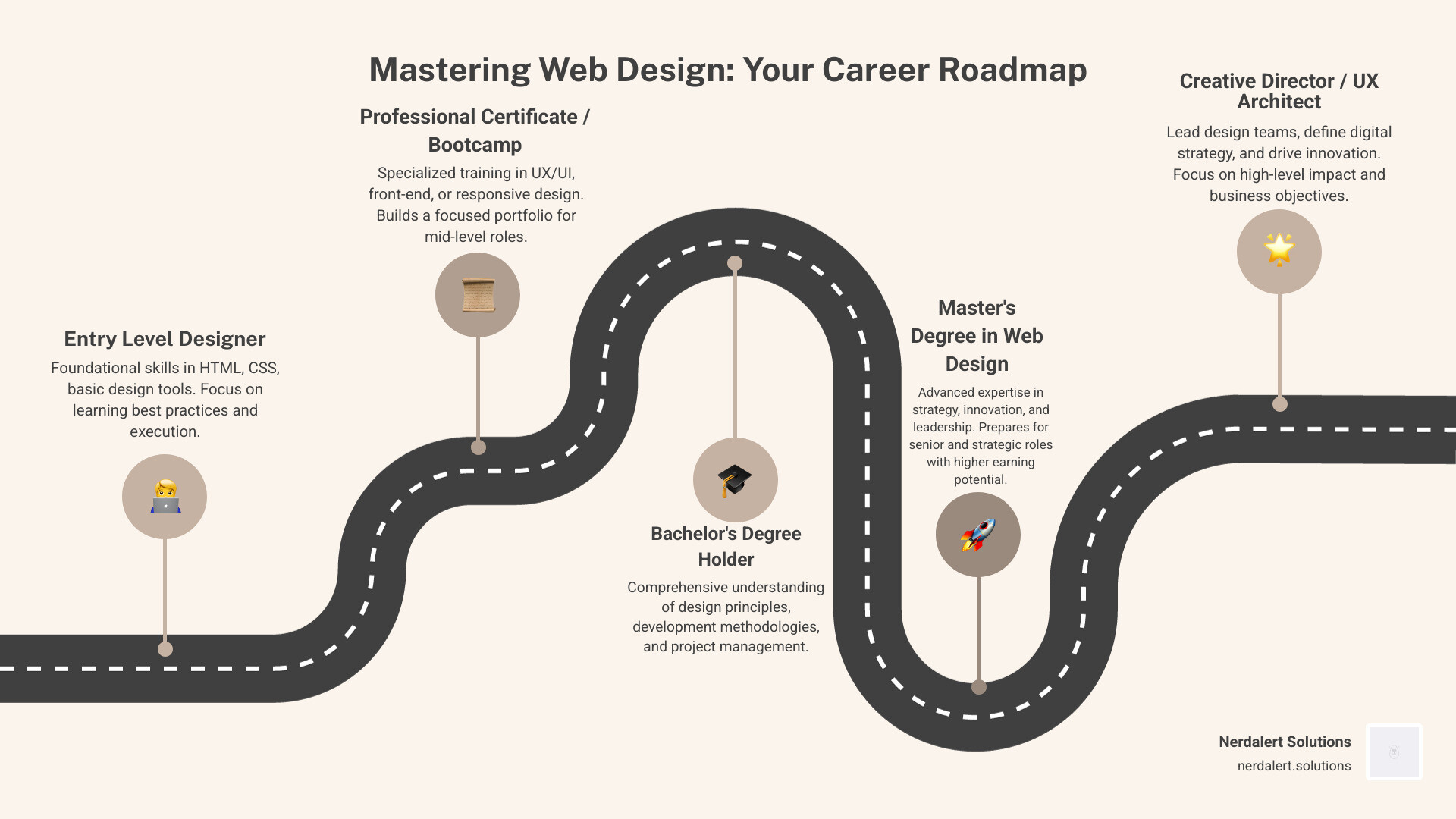
While certificates and bootcamps are great entry points, a master’s degree is a game-changer for those looking to truly master web design and take on leadership roles. It’s the difference between doing web design and strategizing and innovating in the digital space.

A master’s program, like the Digital Media Design Master’s Degree Program at Harvard Extension School or the M.S. in Integrated Design, Business and Technology at USC, is for professionals seeking to deepen their expertise. These programs go beyond foundational skills to develop the knowledge required to create complex multimedia content. A master’s degree equips designers with strategic foresight, and many employers require it for higher-level roles.
Many programs feature a performance-based admission model and offer “stackable certificates,” allowing you to earn credentials as you work toward your full degree.
Beyond the classroom, these programs offer significant benefits:
- Career Advancement: Graduates are prepared for leadership positions and complex design challenges.
- Networking: Access to extensive alumni networks can open doors to incredible opportunities.
- Career Services: University resources provide invaluable career advising and entrepreneurial support.
- Expert Faculty: Learning from active industry professionals ensures the curriculum is current and relevant.
A master’s degree cultivates a holistic understanding of digital media, integrating design, business, and technology to prepare you for impactful roles.
Here’s a quick comparison:
| Feature | Web Design Certificate | Master’s Degree in Web Design/Digital Media |
|---|---|---|
| Depth of Study | Foundational skills, specific tools, quick skill acquisition | Advanced theory, research, strategy, complex problem-solving, interdisciplinary |
| Career Outcomes | Junior designer, web developer, specialist roles | UX Architect, Creative Director, Product Manager, Leadership, Entrepreneurship |
| Typical Salary Range | $45,000 – $75,000 (entry to mid-level) | $80,000 – $150,000+ (senior to leadership roles) |
| Time Commitment | Weeks to a few months | 2-5 years (depending on program and pace) |
The Core Principles of Effective Web Design
Mastering web design requires a deep application of core design principles:
- Visual Hierarchy: Guiding the user’s eye using size, color, and placement to highlight key elements.
- Balance: Creating equilibrium, either symmetrically for a formal look or asymmetrically for a dynamic one.
- Contrast: Using differences in color and size to draw attention and improve readability.
- Repetition: Using consistent design elements like fonts and colors to create unity.
- Proximity: Grouping related items to create logical connections.
- White Space: The empty space around elements, crucial for focus and readability.
- Typography: Arranging type to be legible, readable, and appealing.
- Color Theory: Understanding how colors impact user emotions and perceptions.
These principles are the bedrock of effective creative design and are refined in advanced studies.
The Importance of Responsive Design and Accessibility
In today’s multi-device world, responsive design and accessibility are necessities for anyone who wants to master web design.
-
Responsive Design: This approach ensures a website looks and functions well on all devices, from desktops to smartphones. It involves using a mobile-first approach, fluid grids, flexible images, and media queries to adapt the layout. For businesses in Riverside, Los Angeles, or San Diego, a responsive website is key to reaching every potential customer. We provide responsive web design services to ensure a seamless experience on any device.
-
Accessibility: This means designing websites that can be used by everyone, including people with disabilities. Key aspects include adhering to Web Content Accessibility Guidelines (WCAG), ensuring ADA compliance, designing for screen readers, and using semantic HTML to structure content meaningfully. Our guide on creating accessible websites and ensuring ADA compliance offers more detail. Both responsive design and accessibility are crucial for creating inclusive, user-centered websites.
What to Expect from a Program to Master Web Design
To master web design, you need a comprehensive educational experience that blends theory, practical skills, and real-world application.

A typical master’s program in digital media design spans two to five years, depending on your pace. For instance, Harvard Extension School’s program offers year-round study for accelerated completion. You can browse courses and register online to see typical offerings.
These programs generally feature:
- Program Overview: A deep dive into a curriculum that aligns with industry demands, teaching you to plan, design, and build complex websites and applications.
- Curriculum Structure: Courses that escalate in complexity, from foundational web development to advanced topics like web application frameworks.
- Expert Faculty: Instructors who are active industry professionals, bringing real-world experience from fields like marketing, graphic design, and computer science.
- Project-Based Learning: Hands-on projects and collaborative activities that simulate real-world scenarios, helping you build a strong portfolio and develop problem-solving skills.
- Strong Outcomes: Programs often boast high graduate employment and employer satisfaction rates, a testament to how well they prepare students for the job market.
A master’s program equips you with the skills to not just participate in the digital world, but to lead and innovate within it, taking your understanding of web design to a new level.
Core Curriculum to Master Web Design Fundamentals at an Advanced Level
To master web design requires a profound understanding of its core technologies:
- HTML5: Beyond basic tags, you’ll learn semantic HTML for accessibility and SEO, advanced form elements, and new media tags.
- CSS3: Mastery involves advanced layouts like Flexbox and Grid, CSS variables, animations, and preprocessors like Sass for efficient styling.
- Advanced JavaScript: The curriculum covers core language essentials, asynchronous programming, ES6+ features, and functional programming paradigms to build scalable, interactive web applications.
- Frameworks and Libraries: You’ll learn popular front-end frameworks like React, Angular, or Vue.js to build complex single-page applications.
- Version Control (Git): Essential for collaborative development, you’ll learn Git and platforms like GitHub for tracking changes and deploying projects.
These skills are key to creating fast, efficient websites. Our insights into web design tips to improve loading and performance highlight why these advanced skills are vital. The Web technology for developers portal is another invaluable resource.
The Crucial Role of UX and UI Design
In the journey to master web design, understanding User Experience (UX) and User Interface (UI) is paramount. A website must be intuitive, enjoyable, and effective.
-
User Experience (UX) Design: This focuses on the overall feeling a user has when interacting with a product. It involves user research to understand behaviors and needs, information architecture to organize content logically, and usability testing to identify areas for improvement.
-
User Interface (UI) Design: This focuses on the visual and interactive elements. It includes wireframing to create a skeletal framework, prototyping to simulate user flow, and visual design to create an aesthetically pleasing interface.
The synergy between UX and UI is what lifts a digital product. Understanding this can significantly boost your brand’s image by ensuring your online presence is both beautiful and highly functional.
Specializations: Front-End vs. Back-End Development
As you advance, you’ll encounter the distinct worlds of front-end and back-end development.
-
Front-End Development: This is what users see and interact with. It involves translating design mockups into functional web pages using HTML, CSS, and JavaScript, often with frameworks like React or Angular. Strong UX/UI skills are essential. For a structured learning path, consider resources like The Frontend Developer Career Path.
-
Back-End Development: This is the server-side functionality that powers the website. It involves managing databases, servers, and application logic using languages like Python, Node.js, or PHP. Skills include database management, API development, and security.
-
Full-Stack Development: A full-stack developer is proficient in both front-end and back-end technologies, capable of building a complete web application from start to finish.
From Graduate to Pro: Career Paths and Portfolio Building
Achieving a master’s degree in web design opens up advanced career opportunities that demand strategic thinking, leadership, and specialized expertise.
Graduates are highly sought after for their ability to tackle complex challenges and drive innovation. Here are some potential career paths:
- UX Architect: Designs the overall user experience for complex systems, focusing on user research and information architecture.
- Product Designer: Oversees a product’s design from conception to launch, integrating UX, UI, and business goals.
- Creative Director: Leads design teams and sets the creative vision for projects.
- Senior Front-End Developer: Specializes in advanced client-side development using complex JavaScript frameworks.
- Digital Media Strategist: Develops and implements comprehensive digital media strategies.
- Freelance Web Designer/Consultant: Offers high-level web design and strategy services to clients. Many of our clients in Palm Springs and Moreno Valley benefit from such specialists.
- Principal Software Architect: Designs and oversees the architecture of entire software systems.
- Vice President of Product Design: A high-level leadership role shaping product vision and strategy.
Alumni of top programs often land roles at leading companies like Google, Deloitte, and Hewlett Packard, demonstrating the caliber of opportunities available.
Building a Portfolio to Master Web Design and Attract Premium Clients
While a degree provides the foundation, your portfolio is your most powerful tool to demonstrate you can master web design. It’s a narrative of your problem-solving abilities.
To make your portfolio stand out, especially when targeting premium clients in areas like Los Angeles or San Diego, focus on these strategies:
- Case Studies: Go beyond final designs. Explain the problem, your process (research, wireframing, prototyping), and the measurable impact of your work.
- Project-Based Work: Include complex projects from your master’s program, especially capstone projects that mimic real-world scenarios.
- Demonstrating Problem-Solving: Highlight how you solved specific challenges, such as improving user flow or increasing conversions. Quantify results where possible.
- Showcasing Technical Skills: Mention the frameworks, languages, and tools you used to demonstrate technical proficiency.
- Personal Branding: Your portfolio itself should be a testament to your design skills. Apply principles of small business branding to your own presentation.
A strong portfolio transforms a graduate into a professional. It’s how you show, not just tell, that you’ve mastered the craft, much like how choosing the perfect creative logo design is vital for a business.
Staying Ahead: Latest Trends and Future Directions
To master web design, you must commit to continuous learning and stay aware of the latest trends.
- AI in Design: AI-powered tools are assisting with layout generation, content personalization, and automating repetitive tasks.
- Motion UI and Microinteractions: Subtle animations and interactive elements are becoming more sophisticated to guide users and improve the experience.
- 3D Elements and Immersive Experiences: 3D graphics are being integrated into websites for more engaging visuals, tying into the rise of browser-based VR/AR.
- Voice User Interface (VUI): Optimizing websites for voice search and interaction is a growing trend as smart speakers become more common.
- WebAssembly (Wasm): This technology allows code written in languages like C++ and Rust to run on the web at near-native speed, enabling highly performant web applications.
- Headless CMS: Decoupling the CMS from the front-end offers greater flexibility, allowing content to be delivered to any platform via APIs.
- Greater Personalization: Delivering highly personalized experiences based on user data is the future of web design and digital media.
These trends underscore why a master’s-level education, which emphasizes strategic thinking, is so valuable. Understanding how digital marketing design drives engagement and how it will evolve with these technologies is crucial for success.
Frequently Asked Questions about Advanced Web Design Education
We often get asked about the practicalities of pursuing higher education in web design. Here are some common questions and our expert answers.
How long does it take to complete a master’s program in web design?
The duration of a master’s program varies based on the program and your pace:
- Full-time study: Typically 1.5 to 2 years.
- Part-time study: Often ranges from 3 to 5 years, allowing you to work while studying.
- Accelerated options: Some programs offer year-round study, which can shorten the completion time. Most programs have a maximum time limit, such as 5 years.
It’s important to research specific program requirements.
What are the admission requirements for a master’s program?
Admission to a master’s program is more rigorous than for a certificate. While requirements vary, they commonly include:
- Undergraduate Degree: A bachelor’s degree is almost always required, preferably in a related field like graphic design, computer science, or marketing.
- Work Experience: Many programs prefer or require at least two years of professional work experience.
- Letter of Intent/Personal Statement: A letter outlining your career goals and interest in the program. Some institutions may request a letter demonstrating basic coding knowledge. You can find general guidance on submission instructions on the admissions pages of university websites.
- Portfolio Submission: A strong portfolio showcasing your design and/or development skills is often a critical component.
- Academic Transcripts: Official transcripts from all previous colleges and universities.
- Letters of Recommendation: Usually two or three letters from academic or professional references.
- English Language Proficiency: Proof of proficiency (e.g., TOEFL or IELTS scores) for non-native English speakers.
- Basic Technical Skills: Comfort with web tools like HTML, CSS, and JavaScript may be expected.
Always check the specific admission criteria for each program you’re interested in.
What career opportunities are available after graduating?
A master’s degree in web design or digital media prepares you for leadership and specialized roles with high demand in the digital industry. Graduates are equipped to drive innovation and lead teams.
Rewarding career opportunities include:
- Web Designer (leading complex projects)
- UI/UX Designer, UX Architect, or Product Designer
- Front-End Developer (specializing in advanced frameworks)
- Digital Media Specialist or Strategist
- Freelance Web Designer or Consultant
- Leadership roles like Creative Director or Vice President of Product Design
- Principal Software Architect
Graduates from top programs are often in demand at leading tech companies and agencies, showcasing the significant return on investment of a master’s degree.
Conclusion
The journey to master web design is a continuous one. While foundational skills are essential, pursuing a master’s degree offers a strategic advantage by deepening your expertise, opening doors to leadership roles, and equipping you to innovate in the ever-changing digital landscape. It’s an investment in your career that pays dividends in advanced knowledge and expanded opportunities.
From core design principles and responsive/accessible websites to advanced curriculum in HTML, CSS, JavaScript, and UX/UI, a master’s program provides a comprehensive toolkit. It clarifies the paths of front-end and back-end development, preparing you for specialized roles. A powerful portfolio translates this education into tangible success, while staying ahead of trends like AI in design ensures your skills remain impactful.
For businesses in Riverside and beyond looking to implement cutting-edge design principles, the expert team at Nerdalert Solutions offers comprehensive services that turn vision into reality. We understand the nuances of creative digital design and how it drives online success. If you’re ready to lift your digital presence with sophisticated, user-centered web design, don’t hesitate to reach out.
Contact our web design agency in Riverside today and let us help you achieve your digital goals.