
12 Feb
Why Your San Diego Business Needs to Be Found Locally
Local SEO in San Diego is how your business appears when nearby customers search for what you offer—like “best tacos near me,” “dentist in Hillcrest,” or “plumber in Chula Vista.” It’s the key to being the first choice when a local customer is ready to buy.
Quick Answer: What You Need to Know About Local SEO in San Diego
- Google Business Profile optimization – Your digital storefront that appears in Maps and local pack results
- NAP consistency – Your Name, Address, and Phone number must match everywhere online
- Customer reviews – Recent, positive reviews signal trust and boost rankings
- Local keywords – Target searches like “near me” and neighborhood-specific terms
- Mobile-friendly website – Over 60% of local searches happen on phones
- Local citations – Listings in directories like Yelp, Yellow Pages, and San Diego Chamber of Commerce
San Diego’s market is highly competitive, with over 3 million residents in diverse neighborhoods, plus tourists and cross-border traffic. This creates a complex audience with unique search patterns.
The stakes are high: over 72% of consumers who make a local search visit a store within five miles. This means you have moments to capture a potential customer’s attention before they find a competitor.
Local SEO ensures Google understands where you are, what you do, and why customers should trust you. Done right, it turns searches into foot traffic and revenue. Whether you run a restaurant in Little Italy or a dental practice in Escondido, showing up in local search is essential for competing in San Diego County.
Simple local seo in san diego glossary:
Mastering the Core Components of a Winning Strategy
A winning local SEO strategy requires a strong foundation. It builds trust and signals to Google that you are the best local answer for a customer’s needs.

Optimizing Your Google Business Profile (GBP)
Your GBP is the most important tool for local SEO in San Diego, influencing your visibility in the “local pack” on Google Search and Maps. An optimized profile is essential.
- Complete Setup and Verification: Claim and verify your GBP to establish legitimacy.
- Comprehensive Information: Fill out every section, including business hours, website, phone number, and a compelling description.
- Primary and Secondary Categories: Choose the most accurate primary category and add relevant secondary ones to tell Google what you do.
- Services & Products: Detail your offerings directly in your profile to rank for specific service-related searches.
- Weekly Google Posts: Use Posts to share updates, promotions, and events to keep your profile active.
- Q&A Feature: Monitor and proactively answer user questions to provide valuable information.
- Photo Optimization: Upload high-quality, geotagged photos of your business, products, and team.
An optimized GBP requires ongoing attention. For more in-depth strategies, check out our guide on Google Maps SEO in San Diego.
Building Local Citations and Ensuring NAP Consistency
A “citation” is any online mention of your Name, Address, and Phone number (NAP). Google uses consistent and accurate citations across the web to verify your business information and build trust, which positively impacts local rankings.
Our strategy for citations involves:
- Data Aggregators: Ensuring your information is correct on major data aggregators that feed hundreds of other directories.
- Top Local Directories: Listing your business on prominent directories like Yelp, Yellow Pages, and Facebook.
- Niche Industry Directories: Getting listed on directories specific to your industry (e.g., Avvo for lawyers, Healthgrades for doctors).
- San Diego Chamber of Commerce: A listing with local organizations provides a valuable local citation and builds community trust.
- Citation Cleanup Process: Audit and correct existing inconsistent or incorrect NAP data. Consistency is critical.
Generating and Managing Online Reviews
Online reviews are a powerful trust signal for customers and Google. A steady stream of positive feedback is crucial, as 85% of consumers consider reviews older than 3 months irrelevant.
Our approach to reviews includes:
- Review Generation Strategy: Implement ethical strategies to encourage happy customers to leave reviews.
- Customer Feedback Loop: Make it easy for customers to leave reviews on Google, Yelp, and other relevant sites.
- Responding to All Reviews: Respond promptly and professionally to all feedback to show you value customer experience.
- Building Social Proof and Trust: A high volume of positive reviews builds immense social proof and tells new customers you are reliable.
- Star Ratings Impact: Higher star ratings and more reviews help you rank better and attract more clicks.
For more insights, read Why recent reviews matter to consumers.
On-Page SEO for Local Targeting
On-page SEO ensures your website is optimized for local searches.
- Local Keyword Research: Identify keywords combining your services with San Diego locations (e.g., “emergency plumber San Diego”) and “near me” searches.
- Geo-Targeted Keywords: Integrate these keywords naturally into your website’s content, headings, and image alt-text.
- Creating Location-Specific Pages: If you serve multiple areas, create unique pages for each location (e.g., “Personal Injury Lawyer Downtown San Diego”).
- Neighborhood Pages: Develop unique content for neighborhood-specific pages (e.g., “HVAC Repair North Park”).
- Optimizing Title Tags and Meta Descriptions: Craft unique, keyword-rich title tags and meta descriptions for local pages to improve click-through rates.
- Local Business Schema Markup: Implement schema code to help search engines understand your business information, like address and hours.
Tailoring Your Strategy for San Diego’s Unique Market
A successful local SEO in San Diego strategy must adapt to the city’s unique market, including its demographics, seasonal shifts, and diverse neighborhoods.

Capitalizing on Tourism and Seasonal Demand
San Diego is a major tourist destination, and visitors often use their phones for immediate needs. This creates opportunities for businesses in high-traffic areas.
- Tourist Search Patterns: Identify keywords tourists use for attractions, dining, and activities.
- Optimizing for Attractions: Capture searches related to landmarks near your business, like “restaurants near Gaslamp Quarter.”
- Petco Park Events: Optimize for event-related searches during the baseball season to drive traffic.
- Seasonal Keyword Targeting: Adjust keyword strategies to align with seasonal demands, from summer beach-goers to holiday visitors.
- Mobile-First Optimization for Visitors: Ensure your website is fast and mobile-friendly for tourists on the go.
Reaching the Binational and Bilingual Population
San Diego’s proximity to Tijuana creates a large binational and bilingual population that many businesses overlook.
- Cross-Border Customer Searches: Consider how visitors from Mexico search for services, especially near the border in San Ysidro and Otay Mesa.
- Spanish-Language SEO: Offer Spanish-language content and optimize for Spanish keywords to reach this demographic.
- Bilingual Content Strategy: Develop content that caters to both English and Spanish speakers.
- Hreflang Tag Implementation: Use
hreflangtags to serve the correct language version of your site to users. - Cultural Marketing Relevance: Go beyond language to ensure marketing messages are culturally relevant.
A Neighborhood-by-Neighborhood Approach to local seo in san diego
San Diego is a collection of distinct neighborhoods, each a “micro-market” with unique search patterns. A custom approach is essential.
- Micro-Markets: Analyze the specific search behaviors in neighborhoods like Pacific Beach, Hillcrest, and Chula Vista.
- Hyperlocal Content Creation: Develop content relevant to specific neighborhoods, such as blog posts about local events or service pages mentioning local landmarks.
- Neighborhood-Specific Link Building: Earn backlinks from local community websites and neighborhood associations.
- Top San Diego Neighborhoods with Unique Search Characteristics:
- La Jolla: Upscale services, boutiques, fine dining, tourist attractions.
- North Park: Craft breweries, trendy restaurants, independent shops.
- Hillcrest: Diverse dining, LGBTQ+ community, healthcare services.
- Chula Vista: Family-friendly services, residential focus, binational community.
- Gaslamp Quarter: Nightlife, dining, entertainment, tourist-driven.
- Little Italy: Italian restaurants, cafes, cultural events.
- Pacific Beach: Casual dining, bars, surf shops, younger demographic.
- Downtown San Diego: Business services, corporate, Petco Park.
- Ocean Beach: Bohemian vibe, local shops, dog beach.
- Encinitas (North County): Coastal, health-conscious, yoga, surf.
By understanding these distinct areas, we can craft highly targeted local SEO in San Diego campaigns that truly resonate with local searchers.
Integrating Advanced Tactics for a Competitive Edge
Once your foundation is solid, advanced tactics can provide a significant competitive edge for local SEO in San Diego.
The Role of Mobile and Voice Search Optimization
With over 60% of Google searches happening on mobile—many of them local “near me” queries—mobile and voice search optimization are critical.
- Mobile-First Indexing: Google primarily uses your site’s mobile version for ranking, so it must be mobile-friendly.
- Page Speed and Core Web Vitals: A fast, smooth mobile experience is essential for users and rankings. We focus on optimizing page speed and Core Web Vitals.
- Answering Conversational Queries: Optimize content to answer natural language questions used in voice search (e.g., “What’s the best pizza place near me that’s open now?”).
- Optimizing for Featured Snippets: Structure content with clear headings and concise answers to appear in featured snippets, which voice assistants often use.
- Implementing Q&A Schema: Use Q&A schema to help search engines understand question-and-answer content for voice search.
To ensure your business is optimized for the on-the-go San Diegan, dig into our San Diego mobile SEO strategies for businesses on the Go.
How to Integrate Local and Organic SEO for Maximum Impact
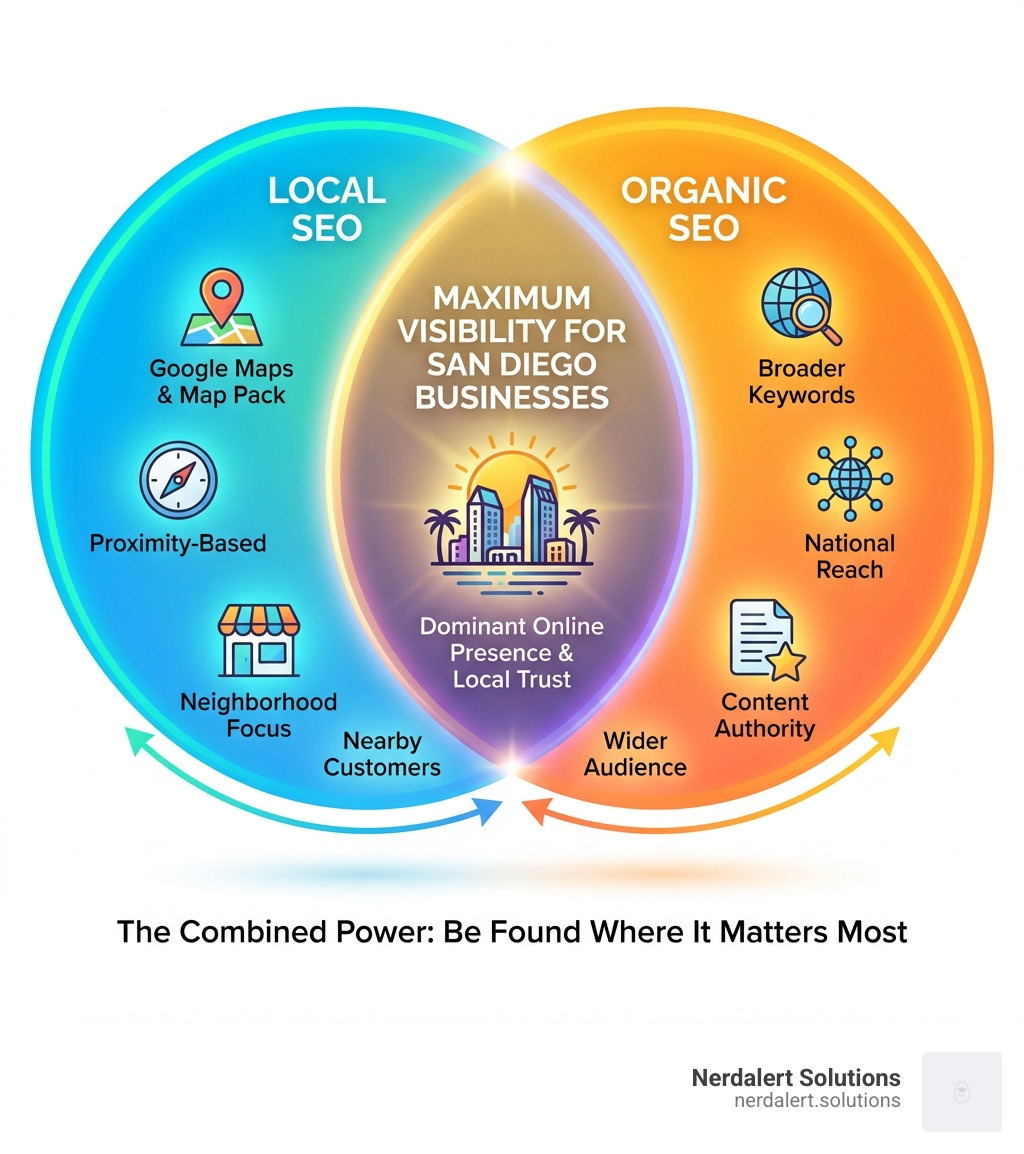
Local and organic SEO should be integrated into a holistic strategy for maximum impact. Local SEO targets geographic queries, while organic SEO builds broader authority.
- Holistic Digital Strategy: We develop a comprehensive strategy that uses local SEO for geo-targeted terms and organic SEO for broader informational searches.
- Content Marketing for Local Audiences: Create high-quality blog posts and guides relevant to your industry and the San Diego community.
- Building Topic Clusters: Organize content into topic clusters with a central “pillar page” to signal authority to Google.
- Strengthening Brand Authority: High-quality content earns valuable backlinks, which boosts both organic and local rankings. For more on building these crucial connections, explore our link building services in San Diego.
Here’s a quick look at how we integrate the two:
| Feature | Local SEO Focus | Organic SEO Focus | Integration Strategy |
|---|---|---|---|
| Keywords | “Near me,” “service + San Diego neighborhood” | Broad, informational, long-tail, national | Use local keywords in on-page content; create informational content with local examples |
| Google Profile | Google Business Profile (GBP) is central | Website is central | Optimize GBP for local search; link GBP to relevant website pages |
| Citations | NAP consistency across local directories | Backlinks from authoritative sites | Ensure NAP consistency; earn local backlinks from community sites, then broader industry sites |
| Content | Location-specific pages, local events | Blog posts, guides, industry news | Create locally relevant blog content; use local examples in broader guides |
| Reviews | Quantity, quality, recency on GBP/Yelp | Testimonials on website, third-party endorsements | Systematically collect reviews; showcase testimonials on website for overall credibility |
| Geographic | Hyperlocal, city-specific, service area | National, international, broader topics | Use location-specific pages (local); use blog for broader topics (organic) with local relevance where possible |
Avoiding Common Mistakes in local seo in san diego
Steer clear of these common local SEO traps:
- Inconsistent NAP Information: Discrepancies in your Name, Address, or Phone number across platforms confuse Google and hurt rankings.
- Ignoring Online Reviews: Failing to respond to reviews or generate new ones is a missed opportunity to build trust.
- Keyword Stuffing in GBP: Overloading your GBP name with keywords is a black-hat tactic that Google penalizes.
- Creating Fake GBP Locations: Using fake locations is a severe violation of Google’s guidelines and can lead to suspension.
- Neglecting Mobile Experience: A slow, non-responsive mobile site will drive away customers and harm your rankings.
- Outdated Information: Failing to update business hours or services on your GBP frustrates customers.
Understanding and adhering to Google’s guidelines is paramount. We always recommend reviewing the official Google Business Profile guidelines to ensure compliance.
Measuring Success and Choosing a Partner for Local SEO in San Diego
Implementing a local SEO in San Diego strategy requires tracking key performance indicators (KPIs) to measure success and refine your approach. Choosing the right partner to manage this process is equally important.
Key Metrics to Track Your Local SEO Performance
We believe in transparent, measurable results. Here are the essential metrics we track:
- Google Analytics 4 (GA4) Setup and Monitoring: Track website traffic, user behavior, and conversions from local search.
- Google Search Console (GSC) Monitoring: Gain insights into impressions, clicks, and average position for keywords driving local traffic.
- Map Pack Ranking Changes: Track your position in the local 3-pack for target keywords, where visibility dramatically increases.
- Google Business Profile Insights: Monitor direct calls, website clicks, direction requests, and photo views from your GBP listing.
- Form Submissions and Lead Tracking: Track contact form submissions and other lead generation actions on your website.
- Calculating Cost Per Lead (CPL): By tracking leads against your SEO investment, we calculate your CPL to demonstrate ROI. Many San Diego SMBs see a 30-60% lower CPL from organic search compared to paid ads after 6-9 months.
How to Choose the Right San Diego SEO Partner
Choosing the right partner for your local SEO in San Diego is a game-changer. Look for a team that understands the local market and delivers tangible results.
- Evaluating Proven Results: Look for partners with case studies demonstrating success with local businesses, focusing on leads and revenue, not just rankings.
- Assessing Local Market Knowledge: Ensure they understand San Diego’s unique neighborhoods, tourism, and binational population.
- Demanding Transparency in Reporting: Insist on clear, regular reporting that explains progress and impact in plain language.
- Communication Style: A good partner is responsive, proactive, and invested in your success.
At Nerdalert Solutions, we pride ourselves on being a San Diego-based partner that aligns with these principles. For a deeper dive into what to look for, refer to our Buyers Guide: Best SEO Services in San Diego for 2025. Also, ensure any partner adheres to Google’s foundational principles, outlined in Google Search Essentials.
Frequently Asked Questions about San Diego Local SEO
Here are answers to common questions about improving local SEO in San Diego.
How much does local SEO cost in San Diego?
The cost of local SEO in San Diego depends on your industry, competition, number of locations, and goals. Most agencies use a monthly retainer.
- Factors Influencing Cost: Highly competitive niches (e.g., legal, medical) or businesses with multiple locations require a more intensive strategy and larger investment.
- Realistic Cost Ranges: For single-location SMBs in San Diego, retainers typically range from $2,000–$6,000 per month. For more competitive or multi-location businesses, this can be $5,000–$12,000+ per month. This investment yields significant ROI when done correctly.
How long does it take to see results from local SEO?
Local SEO is a long-term strategy. While some quick wins are possible in the first 60-90 days, sustainable results take time.
- Foundational Wins (60-90 days): Expect early gains from technical fixes and GBP optimization, including better visibility and small lead increases.
- Meaningful Lead Growth (4-6 months): Businesses often see expanded traffic and more qualified leads.
- Compounding ROI (12+ months): The true power of SEO is its compounding authority over time, often doubling organic-assisted revenue by the 12-month mark.
- Industry Competition: Results may take longer in highly competitive niches.
What are the most important local ranking factors?
Google’s local algorithm prioritizes a few critical areas:
- Google Business Profile Signals: Proximity to the searcher, accurate categories, keywords in the profile, and profile completeness.
- On-Page Signals: NAP consistency on your site, local keywords in content and titles, and high-quality, locally relevant content.
- Link Signals: Inbound links from other local businesses and the overall authority of your website.
- Review Signals: The quantity, velocity, diversity, and sentiment of your online reviews.
- Behavioral Signals: Click-through rate (CTR) in search results, clicks-to-call, and other user engagement signals.
Conclusion: Dominate Your Local Market and Grow Your Business
In San Diego’s competitive market, a strong local SEO in San Diego strategy is a necessity. Millions of local searches happen every month, directly impacting your bottom line by driving real-world visits.
By mastering your Google Business Profile, ensuring NAP consistency, managing reviews, and optimizing your site for local keywords, you build a powerful foundation. Tailoring this approach to San Diego’s unique tourism, binational population, and distinct neighborhoods allows you to connect with customers at the perfect moment. Integrating mobile, voice, and holistic SEO strategies keeps you ahead of the competition.
The path to local SEO success requires expertise and adaptation, but the rewards are clear: increased visibility, more qualified leads, and sustainable business growth.
At Nerdalert Solutions, our data-driven strategies are designed to consistently boost our clients’ Google rankings and generate high-quality leads. We understand the San Diego market and are committed to helping your business thrive.
Ready to stop losing potential customers to rivals and start dominating your local market?