
23 Jan
Why Mobile SEO Matters for Your San Diego Business
Mobile SEO San Diego is the practice of optimizing your website to rank higher in mobile search results for local customers in the San Diego area. If you’re looking for mobile SEO services in San Diego, here’s what you need to know:
What Mobile SEO San Diego Includes:
- Responsive website design that adapts to all screen sizes
- Fast page load speeds (under 3 seconds)
- Local search optimization for “near me” queries
- Mobile-friendly content with short paragraphs and easy navigation
- Google Business Profile optimization for local visibility
- Voice search optimization for conversational queries
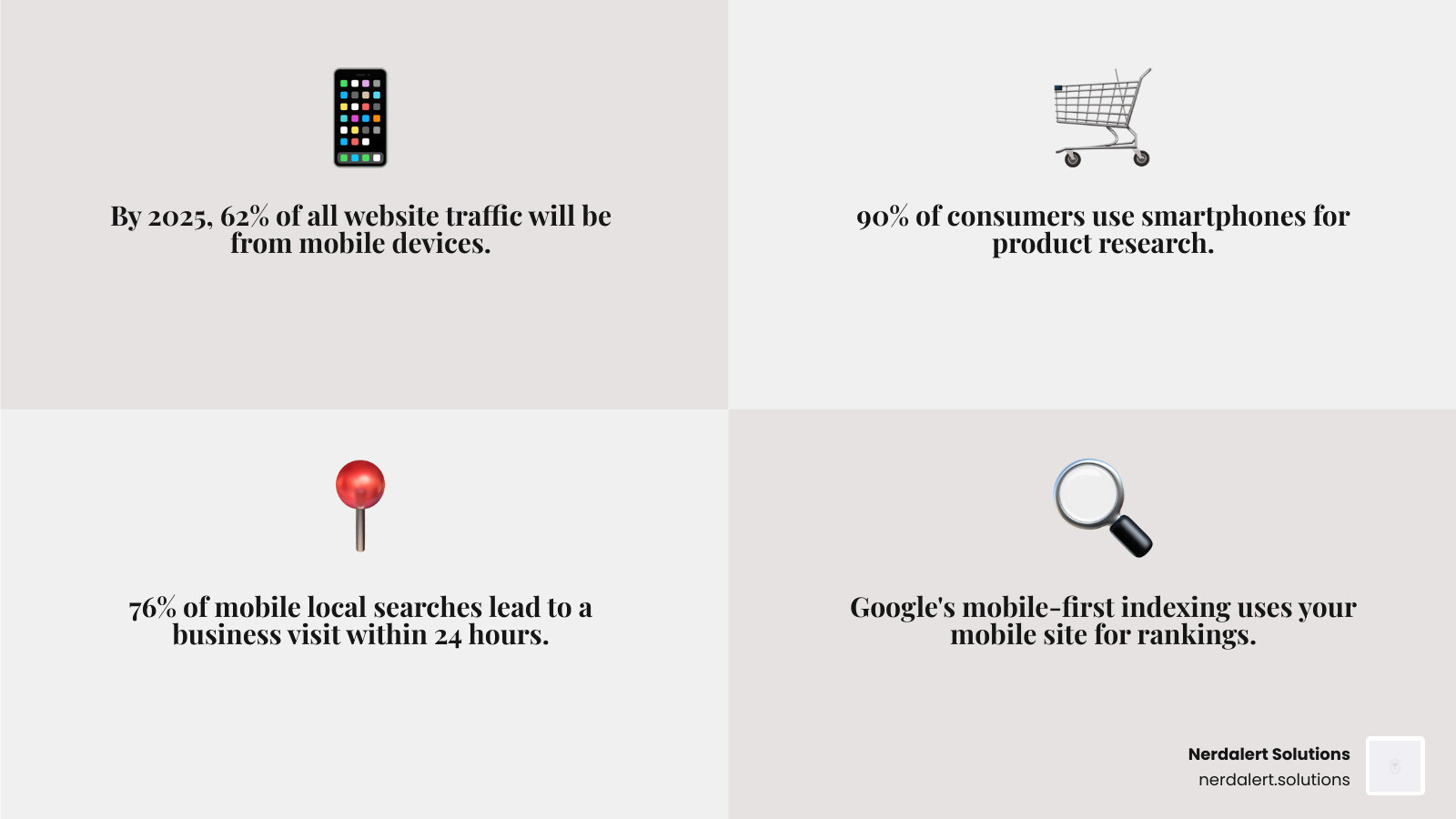
Your potential customers are searching for your business on their phones right now. In 2025, 62% of all website traffic comes from mobile devices. That means more than half of your customers will never see your business if your website doesn’t work well on a smartphone.
San Diego is a mobile-first city. Whether someone’s walking along the Gaslamp Quarter looking for a restaurant, sitting at the beach searching for a surf shop, or commuting on the trolley looking for a service provider, they’re using their phone.
Here’s the hard truth: 90% of consumers use smartphones for product research while shopping, and 76% of people who search for something nearby on their smartphone visit a business within a day. If your website loads slowly, looks broken on mobile, or doesn’t show up in local search results, you’re losing customers to competitors who got mobile SEO right.
Google uses mobile-first indexing now. That means the mobile version of your website is what Google uses to determine your rankings. Your desktop site could be perfect, but if your mobile site is broken, you won’t rank.
The good news? Mobile SEO isn’t rocket science. It’s a set of clear, proven strategies that any San Diego business can implement to capture more mobile traffic and convert more customers.
The Mobile-First Revolution: How Google’s Shift Impacts San Diego Search
The digital landscape has undergone a seismic shift, and nowhere is this more evident than in how people access information online. Mobile devices aren’t just an alternative; they’re the primary gateway to the internet for most users. This has led to a fundamental change in how search engines like Google evaluate and rank websites.
Google has fully switched to mobile-first indexing, which means the mobile version of your website is now the primary platform Google considers for indexing and ranking. What does this mean for businesses in San Diego? It means if your mobile site isn’t up to snuff, your desktop site’s brilliance won’t save your search rankings. Google will crawl and index your site’s mobile version first, and its quality directly impacts your local search visibility.
This shift has profound implications for local search rankings in San Diego. When a potential customer searches for “best tacos near me” or “plumber San Diego,” Google is looking at the mobile-friendliness of your website to decide if you deserve a spot at the top. If your site offers a clunky, slow, or difficult-to-steer experience on a smartphone, you’re essentially telling Google, “Please, don’t show me to mobile users.” And Google obliges.
Mobile vs. Desktop SEO: Key Distinctions
While the core principles of SEO (keywords, content, links) remain, mobile SEO San Diego has distinct characteristics that set it apart from traditional desktop SEO. Think of it like this: you wouldn’t wear a suit to the beach, and you wouldn’t wear board shorts to a business meeting. Both are clothes, but they serve different purposes and environments.

Here are the key distinctions:
- Screen Real Estate: Mobile devices have significantly smaller screens. This impacts everything from layout and font size to image display and navigation. What looks great on a 27-inch monitor can be a jumbled mess on a 6-inch phone.
- User Experience (UX): Mobile users are often “on the go” and seek quick answers. They have less patience for slow loading times, complex navigation, and fiddly buttons. Their attention patterns are different, too; studies show mobile users tend to focus on a central “hot zone” rather than the “F-pattern” common on desktops.
- Navigation: Intricate menus that work well on desktop can be unusable on mobile. We need touch-friendly elements, clear calls to action, and simplified menu structures (like hamburger menus) that don’t overwhelm the small screen.
- Search Queries (Local Intent): Mobile searches are far more likely to have local intent. People use their phones to find businesses near their current location. This makes local SEO an inseparable part of mobile strategy.
- Ranking Signals: While many ranking signals overlap, mobile-specific factors like page speed (especially Core Web Vitals), mobile usability, and the absence of intrusive interstitials carry significant weight in mobile search rankings.
How Mobile-First Indexing Affects Your San Diego Business
The message from Google is clear: the mobile version of your website is your primary version. This means that all the fantastic content, high-quality images, and robust technical SEO you’ve built for your desktop site won’t count as much if they aren’t equally accessible and optimized on mobile.
For your San Diego business, this has several critical implications:
- Ranking Implications: If your mobile site isn’t optimized, it won’t rank well, regardless of your desktop site’s performance. This directly impacts your visibility for local searches, which are predominantly done on mobile.
- Content Parity: Google expects the content on your mobile site to be the same as your desktop site. If you have less content, fewer images, or different schema markup on your mobile version, Google might not fully understand or index your pages, leading to lower rankings.
- Need for Responsive Design: Google strongly recommends responsive design. This approach ensures your website adapts seamlessly to any screen size, providing a consistent user experience and maintaining content parity across devices. It’s often the most efficient way to meet mobile-first indexing requirements. If you’re curious about how a top-notch website can help your business, check out our insights on web design in San Diego.
Core Strategies for Mobile SEO San Diego
Now that we understand the “why,” let’s dive into the “how.” Effective Mobile SEO San Diego isn’t about quick fixes; it’s about implementing a comprehensive strategy that prioritizes the mobile user. We, at Nerdalert Solutions, focus on custom, data-driven strategies that consistently boost our clients’ Google rankings and generate high-quality leads.
Our core strategies revolve around:
- Responsive Design: This is Google’s recommended approach. A responsive website uses the same URL and HTML code across all devices, but its CSS adjusts the layout and content display based on screen size. It simplifies maintenance and ensures content parity.
- Page Speed: Mobile users are impatient. A slow site is a losing site. We’ll explore this in detail below.
- User Experience (UX): Beyond speed, how easy and enjoyable is your site to use on a phone? This includes navigation, readability, and interaction design.
- Technical Optimization: Ensuring Google can easily crawl, index, and understand your mobile content is crucial.
- Content Strategy: Adapting your content for mobile consumption without sacrificing quality.
For a deeper dive into overall SEO principles that apply across devices, you can explore The Complete Guide to Mobile SEO.
Optimizing for Speed and User Experience
Imagine waiting for a slow-moving trolley in downtown San Diego when you’re already late. That’s how mobile users feel about slow-loading websites. Speed is paramount.
- Page Load Time: Google research shows that 53% of mobile users leave a mobile site if it takes longer than three seconds to load. That’s over half your potential customers gone before they even see your content! We aim to get your pages loading in under that critical three-second mark. You can check your site’s speed using Google PageSpeed Insights.
- Core Web Vitals: These are Google’s key metrics for measuring user experience.
- Largest Contentful Paint (LCP): Measures loading performance. Essentially, how long does it take for the main content of your page to become visible?
- Interaction to Next Paint (INP): Replaced First Input Delay (FID) and measures responsiveness. It assesses how quickly your page responds to user interactions like clicks or taps. An INP score of 200ms or less indicates good responsiveness.
- Cumulative Layout Shift (CLS): Measures visual stability. Does your content jump around while loading, making users accidentally click the wrong thing? We want to avoid that.
- Image Compression: Large, unoptimized images are often the biggest culprits for slow page speeds. We ensure images are compressed without losing quality and use modern formats like WebP.
- Caching: Implementing efficient caching strategies allows repeat visitors to load your site much faster.
- Thumb-Friendly Design: Most mobile users steer with their thumbs. Buttons, links, and interactive elements should be large enough and spaced appropriately to be easily tapped. Touch targets should be around 48 pixels in size, and interactive elements around 32 pixels apart.
- Avoiding Intrusive Pop-ups: We all hate them. So does Google. Google penalizes “intrusive pop-ups” that cover the main content on mobile sites, especially those that appear immediately upon page load. They disrupt the user experience and can severely impact your rankings.
Technical Foundations for Mobile SEO San Diego
Beyond speed, the technical setup of your mobile site tells Google how to interact with your content.
- Responsive Design Implementation: As mentioned, this is our go-to. It ensures your website adapts gracefully to any screen size, from a small smartphone to a large desktop monitor. This single URL approach simplifies crawling and indexing for Google and reduces common mobile site mistakes. If you’re looking to upgrade your online presence, learning how to make a responsive website is a fantastic first step.
- Viewport Meta Tag: This small but mighty line of code in your website’s header tells browsers how to control the page’s dimensions and scaling on mobile devices. It’s essential for responsive design to work correctly:
. - Structured Data (Schema): Implementing structured data, or schema markup, helps search engines understand the context of your content. This can lead to rich snippets in mobile search results, like star ratings, product availability, or event details, making your listing stand out. Tools like Merkle’s Schema Markup Generator can help simplify this process.
- HTML5 vs. Flash: Flash is a relic of the past and is not compatible with mobile devices. We ensure your website uses modern, mobile-friendly technologies like HTML5 for multimedia and interactive elements.
- Mobile-Friendly Content & Readability: Content needs to be easily digestible on a small screen.
- Short Paragraphs: Break up large blocks of text into 2-3 line paragraphs.
- Concise Introductions: Get straight to the point. Mobile users are scanning for answers.
- Ample White Space: Give your text and images room to breathe. This improves readability and reduces visual clutter.
- Appropriate Font Size: Ensure your text is easily readable without zooming. We recommend 14px to 16px for body text.
For a broader understanding of our digital marketing services, including how we handle technical optimization, visit our main SEO Services page.
Advanced Tactics: Integrating Local and Voice Search
For San Diego businesses, local SEO and voice search aren’t just “nice-to-haves” for mobile; they’re absolute necessities. These tactics often go hand-in-hand, creating a powerful synergy for capturing customers who are actively looking for businesses like yours, right here, right now.
Dominating Local Search on Mobile
Think about your own behavior. If you’re out and about in San Diego and need a coffee shop, do you pull out your laptop? Probably not. You grab your phone and search “coffee shop near me.” These “near me” searches are booming, with over 1.5 billion searches each month containing ‘near me’. This is where local SEO shines.
- Google Business Profile Optimization: Your Google Business Profile (GBP) is your virtual storefront on Google Maps and local search results. Optimizing it is non-negotiable for Mobile SEO San Diego. We ensure your GBP is complete, accurate, and regularly updated with:
- Precise business name, address, and phone number (NAP).
- Accurate business hours.
- High-quality photos and videos.
- Relevant categories and services.
- Customer reviews and responses.
You can get started by claiming and optimizing your Google Business Profile.
- Local Keywords: We conduct thorough keyword research to identify terms San Diegans use when searching for your products or services locally (e.g., “vegan restaurant North Park,” “tire shop La Jolla”).
- Geotargeting: Ensuring your website and online listings specifically target San Diego and its surrounding neighborhoods (like La Jolla, Pacific Beach, Coronado, or Chula Vista) is crucial.
- Customer Reviews: Positive reviews on your GBP and other platforms act as social proof and significantly influence local mobile searchers. We help you encourage and manage these reviews.
- NAP Consistency: Your business’s Name, Address, and Phone number must be consistent across all online directories and listings. Inconsistencies can confuse search engines and hurt your local rankings.
To dive deeper into how we get San Diego businesses to show up prominently on local maps, check out our Google Maps SEO San Diego services.
Capitalizing on Voice Search Optimization
“Hey Google, find me a highly-rated seafood restaurant in San Diego.”
Voice search is no longer a futuristic gimmick; it’s a daily reality for many. 40% of adults use voice search daily, and most of these searches happen on mobile devices. Voice search queries are typically longer, more conversational, and often question-based, mimicking natural language.
- Long-Tail Keywords: Instead of short, choppy keywords, voice search uses more descriptive phrases. We optimize your content for these longer, more specific queries.
- Question-Based Queries: People often ask questions when using voice search. We identify common questions related to your business and integrate them into your content, providing direct answers.
- FAQ Pages: Dedicated FAQ pages are perfect for voice search optimization. They directly answer common questions, making your site a valuable resource for search engines.
- Featured Snippets: Optimizing for voice search often aligns with optimizing for featured snippets (those quick answer boxes at the top of Google’s search results). Providing concise, direct answers to questions increases your chances of appearing here.
- Conversational Content Structure: We structure content to be more conversational and easy to understand, mirroring how people speak naturally.
- Schema for Voice Search: Specific schema markup (like
QuestionandAnswerschema) can help search engines better understand your content’s relevance to voice queries. Pages with Article, HowTo, or FAQ schema are nearly 80% more likely to be cited by large language model tools.
For a comprehensive approach to getting your business found online, including these advanced strategies, explore our full range of SEO services in San Diego.
Measuring Success and Avoiding Common Mistakes
You wouldn’t steer the San Diego Bay without a compass, and you shouldn’t steer your mobile SEO without clear metrics. Measuring your campaign’s success allows us to understand what’s working, what’s not, and how to continuously improve. Equally important is recognizing and avoiding common pitfalls that can derail even the best intentions.
How to Measure Your Mobile SEO Campaign’s ROI
We believe in transparency and data-driven results. Measuring the Return on Investment (ROI) of your Mobile SEO San Diego efforts involves tracking specific Key Performance Indicators (KPIs):
- Google Analytics: This is our go-to tool for understanding user behavior. We track:
- Mobile Traffic Tracking: We segment your traffic to see how many users are accessing your site from mobile devices. This gives us a clear picture of your mobile audience.
- Bounce Rate: A high mobile bounce rate can indicate poor mobile UX or slow loading times. We aim for a low bounce rate, meaning users are finding what they need and staying on your site.
- Conversion Rates: Are mobile users completing desired actions (e.g., making a purchase, filling out a form, calling your business)? This is the ultimate measure of success for lead generation.
- Dwell Time: How long do users spend on your mobile pages? Longer dwell times often correlate with higher engagement and satisfaction.
- Google Search Console (GSC): This essential tool provides insights directly from Google about your site’s performance in search. We use GSC to monitor:
- Mobile Keyword Rankings: We track your site’s position for target keywords specifically on mobile devices.
- Mobile Usability Reports: GSC highlights any mobile usability errors Google detects, such as small font sizes or unclickable elements.
- Core Web Vitals Report: This report shows your site’s performance against Google’s crucial UX metrics (LCP, INP, CLS) for mobile.
You can explore the power of Google Search Console for your business.
By carefully tracking these metrics, we can provide clear reports on your campaign’s effectiveness and make informed adjustments to maximize your ROI. For a deeper dive into how we build strong online presences for our clients, check out our Link Building Services San Diego page, as link building is a crucial aspect of overall SEO.
Common Mobile SEO Mistakes San Diego Businesses Make
Even with the best intentions, businesses often stumble when it comes to mobile SEO. Here are some common mistakes we see San Diego businesses make, and how we help you avoid them:
- Slow Page Speed: This is the cardinal sin of mobile SEO. As we mentioned, over half of mobile users will abandon your site if it takes longer than three seconds to load. We systematically identify and fix speed bottlenecks.
- Non-Responsive Design: Relying on a separate mobile site (like
m.yourwebsite.com) or having a desktop site that simply shrinks on mobile is outdated and often leads to poor UX and content parity issues. Responsive design is the way to go. - Intrusive Interstitials: Those annoying pop-ups that block content on mobile? Google actively discourages intrusive pop-ups and may penalize sites that use them. We ensure any necessary pop-ups (like cookie consents) are mobile-friendly and non-intrusive.
- Blocking CSS/JS in Robots.txt: In the past, some webmasters blocked CSS and JavaScript files to save crawl budget. However, Google needs to access these files to properly render and understand your mobile pages. Blocking them can severely hurt your mobile rankings. We ensure Googlebot can crawl all necessary resources.
- Forgetting Local Signals: For a local business in San Diego, neglecting to optimize your Google Business Profile, get local reviews, or ensure NAP consistency across directories is a huge missed opportunity. These local signals are amplified on mobile.
- Poor User Experience: Small, unreadable fonts, tiny buttons, horizontal scrolling, and complex navigation menus are all UX killers on mobile. We prioritize intuitive, thumb-friendly design.
Google provides a helpful resource for identifying common mobile site mistakes that you can review. Avoiding these pitfalls is crucial for your mobile success.
Conclusion: Partner with an Expert to Lift Your San Diego Business
The world is mobile, and your business needs to be too. For San Diego businesses, mastering Mobile SEO San Diego isn’t just about keeping up; it’s about getting ahead. We’ve explored why mobile SEO is critical, how Google’s mobile-first indexing has revolutionized search, the core strategies for optimizing your site, and advanced tactics like local and voice search. We’ve also highlighted the importance of measuring success and sidestepping common mistakes.
The key takeaway is this: a successful mobile SEO strategy requires a holistic approach that integrates technical excellence, user-centric design, and smart content creation. It’s a continuous process of optimization and adaptation.
For many businesses, navigating the complexities of mobile SEO can feel overwhelming. That’s where an experienced partner comes in. At Nerdalert Solutions, we specialize in delivering custom, data-driven strategies that consistently boost our clients’ Google rankings and generate high-quality leads. We understand the nuances of the San Diego market and how to translate mobile traffic into tangible business growth.
The benefits of partnering with a mobile SEO expert like us are clear:
- Expertise and Experience: Our team brings years of experience and deep knowledge of Google’s algorithms and mobile best practices. We stay ahead of trends, including the rise of AI in search and the increasing ubiquity of 5G, which will further accelerate mobile browsing.
- Time Savings: Mobile SEO is a time-consuming endeavor. We handle the heavy lifting, allowing you to focus on running your business.
- Data-Driven Results: We don’t guess; we analyze. Our approach is built on meticulous research and continuous monitoring to ensure every effort contributes to your bottom line.
- Competitive Edge: In a vibrant market like San Diego, a superior mobile presence can be the differentiator that attracts new customers and keeps you ahead of the competition.
Don’t let your San Diego business get left behind in the mobile revolution. Let us help you craft a powerful Mobile SEO San Diego strategy that drives traffic, engages customers, and boosts your bottom line.
Ready to transform your mobile presence? Get a professional Mobile SEO San Diego strategy from Nerdalert Solutions today.